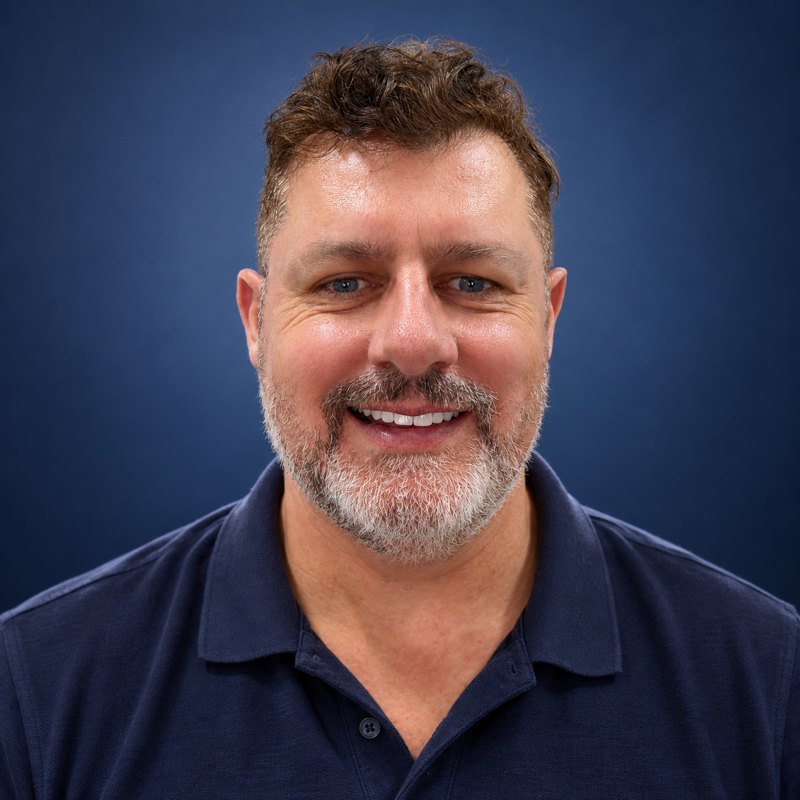
I’ve been a Parramatta Eels supporter my whole life.
They haven’t won a premiership since 1986. I was 12.
My dad’s an Eels tragic. So was my grandfather. So is most of the family. Every season starts the same way.
“This is our year.”
It generally isn’t.
That tells you most of what you need to know about resilience. And now I’ve got a son, so this completely unnecessary lesson gets handed down another generation.
My name is Scott Feeney, and I’m the founder of Knife Kite. I’m 52, a 15-year Royal Australian Navy veteran, a husband and a new dad.
In a strange way, I feel like my real life is only just getting started.
I’ve had a few lives already.
Parramatta, then the beach
I was born in Parramatta in Sydney’s west.
Growing up there gave me two things: I’m comfortable around people from just about any background, and, through absolutely no fault of my own, I got the Eels.
When I was about 10, the family moved up to the NSW Central Coast.
Completely different world.
Beaches and national parks on the doorstep. I learnt to surf, made new friends and assumed I’d spend the rest of my life there.
I was very wrong about that.
Not exactly a straight line
Before the Navy, I did a bit of everything.
I worked in a wool store alongside my dad, dealing with everyone from business executives to truck drivers and shed workers.
I studied nursing but didn’t finish the degree.
Australia was in a brutal recession, the family was struggling with the mortgage, and helping at home had to come first.
We lost the family home anyway.
I carried debt until I was 33.
Along the way I worked in hospitality, at a servo, as a massage therapist, and for years in a nursing home doing palliative care.
Looking back, one thread runs through all of it.
People.
I can talk to pretty much anyone.
I like solving problems.
And I’ve always had a tendency to look out for the person having a rough time.
Fifteen years in the Navy
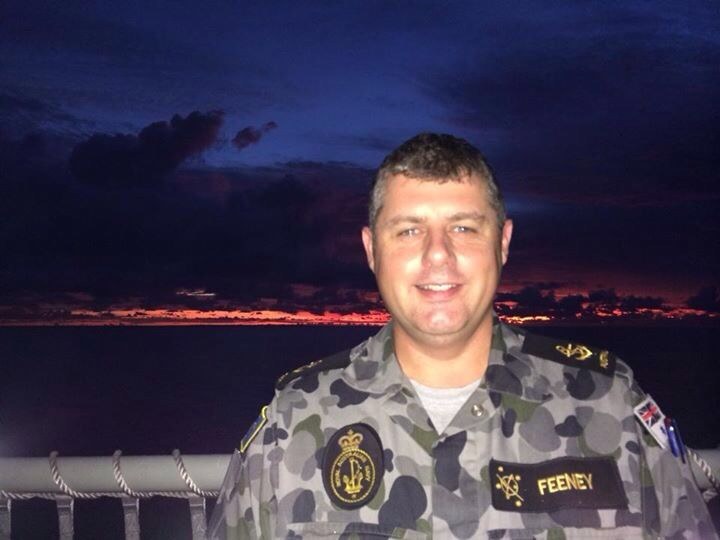
At 28, I joined the Royal Australian Navy.
I stayed for 15 years.
My job was communications and information systems, but like everyone in the Navy, I was a sailor first.
At sea, everyone trains for emergencies.
Fire.
Flooding.
Gas leaks.
Things going wrong at inconvenient times.
When you’re on a ship in the middle of the ocean, you can’t exactly call someone to come and sort it out.
The technical side covered everything from radio and satellite communications to IT infrastructure, networks, hardware, software, signalling and cryptographic security.
Some of that work involved highly sensitive systems and information.
Trust, security and accountability weren’t corporate values written on a wall.
They were simply part of the job.
I managed teams on larger ships, worked solo on smaller ones, and at times worked directly with senior command.
The thing I got really good at was taking something complicated and explaining it differently depending on who was standing in front of me.
The commanding officer didn’t need the same explanation as the bloke working down below decks.
But both needed to walk away knowing what was happening, what mattered and whether it was under control.
That’s stayed with me.
So has something else the Navy taught me:
Good systems matter most when people are busy.
You can’t build anything important around everyone remembering everything.
The right information has to reach the right person at the right time.
People need to know what they’re responsible for.
And when something falls through a crack, there needs to be a way to catch it.
I didn’t know it then, but that thinking would end up shaping the businesses I’m building now.
Leaving was harder than joining
I left the Navy in 2018.
For 15 years I’d been Scott from the Navy.
Then one day I was just Scott, and I didn’t really know who that was.
I also didn’t understand how burnt out I was.
Eventually I was diagnosed with severe depression and PTSD.
There were business attempts.
A limousine business ran straight into COVID.
I drove Uber.
I worked as a funeral director.
I got behind financially.
For a while I thought I needed to become somebody completely different.
At one point I was living in a campervan, travelling up and down Australia’s east coast trying to work out what came next.
Then something shifted.
I stopped trying so hard to become somebody.
I realised I’d already lived a pretty remarkable life.
I’d served my country.
I’d helped people.
I’d travelled the world and met incredible people.
I’d stuffed things up.
I’d been broke.
I’d started businesses that didn’t work.
I’d made some terrible decisions and some good ones.
And I was still here.
That was enough.
I didn’t need to invent a new Scott.
I needed to work out what the existing one was going to do next.
How I accidentally moved to Vietnam
Then an old Navy mate called.
He was going to Vietnam and reckoned I should come along.
I told him I couldn’t afford an overseas holiday.
He said the flight was about $300 and he’d sort the accommodation.
I thought he was full of shit.
He wasn’t.
So I went.
We started in Saigon.
Not really my thing.
Then Da Lat.
Much more my thing.
Then Nha Trang.
Eventually we went separate ways and I headed to Da Nang.
My first week was terrible.
I’d booked a hotel room with no windows and completely destroyed my sleep pattern.
But outside that room, something about Da Nang felt different.
I found an apartment with big windows and a view towards the sea.
After all those years in the Navy, I’ve never lost my connection to the ocean.
It settles something in me.
I was enjoying it so much that when I finally checked whether I could extend my trip, I discovered my flight had left two days earlier.
Apparently I’d accidentally moved to Vietnam.
I sorted my visa, moved closer to the beach and stayed.
Eventually I met a girl.
One thing led to another.
We got married.
And in January 2026, our son arrived.
A month early.
While I was out of the country doing a visa run.
Timing has never been one of my strongest attributes.
Becoming a dad at 52 changes the equation
Today I live in Vietnam while building Australian businesses.
Long term, I’d love our family to split its time between both countries.
I want my son to know where his dad came from.
I want him near the ocean.
I want him to travel.
I want him to grow up around people who don’t necessarily look, sound or think like him.
And I want to actually be there for it.
That’s changed the kind of business I want to build.
I’m not into hustle culture.
If someone genuinely loves working 80 hours a week, good for them. They’re living their dream.
But most of us started businesses because we wanted more freedom, not another job that owns every waking hour.
I want to build something profitable and substantial that eventually works without me being involved in every little decision.
Funnily enough, that’s pretty much the problem I want Knife Kite to help other business owners solve.
Building things nobody paid for
That Navy obsession with systems never really left me.
Over the last few years I’ve gone deep into technology.
Very deep.
I’ve spent thousands learning new tools.
I’ve built agents, applications, workflows and more business ideas than any sensible person should attempt at once.
Some of them were bloody impressive.
There was just one problem.
Nobody had paid me for most of them.
That’s been one of the most useful lessons I’ve learnt in business:
Technology isn’t the business.
A website is a tool.
Automation is a tool.
Software is a tool.
AI is a tool.
None of them magically create a successful business.
A business still needs to solve a real problem for a real person.
Then people I knew needed help
Knife Kite got real when people I actually knew needed help.
Not theoretical avatars on a whiteboard.
Real business owners.
Good people who were good at what they did but buried by everything that had piled up around it.
One of the first was the brother of a friend I’ve known for about 10 years.
He’d built a real business, but the admin, systems and complexity around it were becoming a problem.
Then I looked at my accountant, someone I’d served with years earlier.
She’d helped me enormously when I was years behind with the ATO and needed someone who actually gave a shit.
Now I could see her working weekends and stressing over systems that should have been making her life easier.
Different businesses.
Different problems.
Same pattern.
Being good at the job isn’t the same as being good at everything
Plenty of small businesses start because somebody is genuinely good at something.
A tradie thinks he can deliver better work than his boss.
An accountant knows she can look after clients better.
A landscaper takes pride in work other people rush.
So they go out on their own.
Then the business grows, and suddenly being good at the thing isn’t enough.
Now you’re supposed to understand websites, Google, reviews, enquiries, follow-up, social media, staff and admin.
Plus whatever new piece of technology someone has decided you absolutely need this month.
That’s where things start getting messy.
A good business owner doesn’t need another pile of tools.
They need the right systems around the work they’re already good at.
That’s what I’m building Knife Kite around.
Found. Answered. Followed Up. Won.
The idea is simple.
A customer needs to be able to find your business.
When they reach out, something needs to happen.
If they don’t decide straight away, somebody needs to follow up.
And when a genuine opportunity needs a human, the right person in the business needs to know about it.
Found. Answered. Followed Up. Won.
That’s the customer journey I care about, and Knife Kite works on both sides of it.
Kite Visibility is about strengthening the online presence customers use to discover and judge your business.
Knife Response is about what happens after somebody reaches out.
What’s under the bonnet can be sophisticated.
The business owner’s experience shouldn’t be.
I’m not here to sell technology for technology’s sake.
I want the right tools making the business work better.
That’s it.
No bullshit
I won’t pretend Knife Kite has been around for 20 years.
It hasn’t.
I won’t manufacture case studies or pretend we’ve made clients millions of dollars when we haven’t.
And I’m not going to tell you AI will run your business while you sleep.
It won’t.
I won’t recommend something just because there’s money in selling it to you.
And I’m not interested in working with someone who wants to throw money at a problem while refusing to change anything.
If you already know everything, you don’t need me.
What I can promise is that I’ll take your business seriously.
I’ll ask questions and look for the actual problem rather than prescribing whatever happens to be on the menu.
If something’s broken, I’ll tell you.
If you don’t need something, I’ll tell you that too.
If I don’t know, I’ll say so and find out.
I’ve spent most of my working life in places where people had to trust I’d do what I said I’d do.
I don’t see why business should be any different.
So that’s me
That’s the bloke behind Knife Kite.
I’ve succeeded at some things and failed spectacularly at others.
I’ve spent too much money learning.
I’ve built things nobody wanted to buy.
I’ve spent too much time overthinking instead of doing.
And I’ve finally reached the point where I’m far more interested in doing the work than looking like I know everything.
I’m building Knife Kite because I think I can genuinely help good business owners build better businesses.
And I’m building it for my own family.
Something useful.
Something that lasts.
Something profitable.
And something that eventually gives me more freedom rather than less.
However you found your way to Knife Kite, whether I reached out, someone pointed you here or you stumbled across it, hopefully you now know a bit more about the bloke behind the screen.
Have a look around.
And if something here sounds familiar in your own business, say g’day.
Scott Feeney
Founder, Knife Kite